Shopify search buying guide
Best Shopify search apps: eight options by use case
Choose Nimstrata for Google Cloud search on Shopify, Shopify Search & Discovery for a free baseline, Boost or Fast Simon for discovery workflows, Searchanise for catalog-based plans, or Algolia for configurable search. Include Bloomreach and Constructor when evaluating enterprise platforms. The best fit depends on your catalog, budget and team.
Originally by Jason Knott · Updated by Nimstrata
Published · Reviewed
Jason is a managing partner at Nimstrata with product, UX, and SaaS experience.
We build Retail Cloud Connect, so this is a vendor-authored guide. Our fit recommendations are editorial judgments, based on the official sources linked below, not a hands-on benchmark or a universal ranking. Prices are in USD and were checked on the review date.
The shortlist at a glance
| App | Consider for | Published pricing |
|---|---|---|
| Nimstrata Retail Cloud Connect | Google Cloud AI Commerce Search on Shopify | From $99/month, plus usage and catalog charges |
| Shopify Search & Discovery | A free starting point for native Shopify discovery | Free |
| Boost AI Search & Filter | Search, filters and merchandising in one app | Launch from $29/month; pricing varies with online GMV |
| Fast Simon AI Search & Filters | Search and visual merchandising with session-based plans | Free for 100 monthly sessions; Starter $39.99/month |
| Searchanise Search & Filter | Search and filters with catalog-based plan allowances | Basic $19/month for up to 1,500 products; Plus plans differ |
| Algolia AI Search & Discovery | Teams evaluating configurable search across experiences | Free allowance; paid plans meter requests and records |
| Bloomreach Discovery | Retailers evaluating an enterprise discovery platform | Connector free to install; platform charges billed separately |
| Constructor Connect | Enterprise discovery using shopper behavior | Connector free to install; confirm external platform charges |
Allowances and paid tiers differ. Confirm your expected bill with each vendor; starting prices are not like-for-like quotes.
How to make a useful comparison
Choose a small set of real shopping tasks before opening a demo. Use your own query logs and catalog so every vendor is solving the same problem. Include the languages, markets and variant combinations your shoppers use, and confirm whether your traffic supports a useful personalization test.
- Relevance: test exact product names, categories, misspellings and descriptive queries. Record useful results, empty results and unavailable products.
- Merchandising: check filters, variants, availability, promotions and collection ordering. Include tasks the merchant team must perform without a developer.
- Implementation: validate your theme or headless storefront, product cards, catalog sync and analytics. Agree who owns setup and ongoing changes.
- Economics: estimate normal and peak usage. Compare total cost with the value of better discovery, then validate outcomes with a controlled test.
Request a search relevance report to establish a starting point, or model Nimstrata pricing using your catalog and traffic.
1. Nimstrata Retail Cloud Connect
Connects your Shopify catalog and storefront to Google Cloud's AI Commerce Search using theme app blocks. A fit for teams that want Google-powered discovery with a managed Shopify integration.
- Why shortlist it
- Managed catalog sync and storefront integration; a choice of managed or enterprise Google Cloud billing.
- What to check
- Budget for search and browse usage as well as the base subscription. Enterprise billing also includes separate Google Cloud costs.
- Pricing
- From $99/month, plus usage and catalog charges.
2. Shopify Search & Discovery
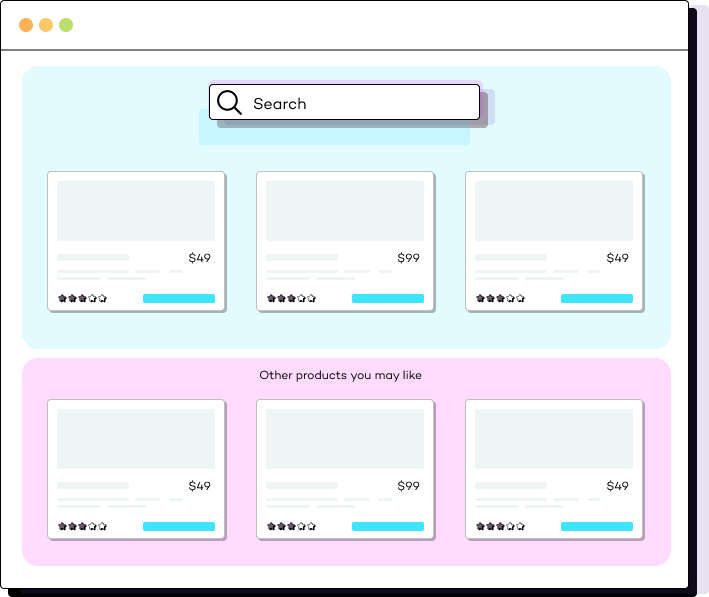
Shopify's own app includes filters, synonym groups, product boosts and related-product recommendations. Start here when your existing search meets most needs and you want to improve its configuration.
- Why shortlist it
- No additional app subscription; familiar Shopify administration.
- What to check
- Check your theme compatibility and test your difficult queries before deciding whether the built-in controls cover your requirements.
- Pricing
- Free.
3. Boost AI Search & Filter
Combines AI search, custom filter trees, merchandising campaigns and recommendations. Consider it when your merchandising team wants a broad set of discovery tools in one Shopify app.
- Why shortlist it
- Search, filtering and merchandising workflows in a single product.
- What to check
- Price and feature access depend on the plan and online GMV. Confirm the tier needed for personalization and your campaign count.
- Pricing
- Launch from $29/month; pricing varies with online GMV.
4. Fast Simon AI Search & Filters
Offers search, autocomplete, filters and merchandising, with plan allowances based on monthly sessions. Consider it when visual merchandising and existing app integrations are central to your evaluation.
- Why shortlist it
- A no-code editor and a range of search and merchandising features.
- What to check
- Match your traffic and required features to the plan. The free allowance is small, and advanced merchandising is tier-dependent.
- Pricing
- Free for 100 monthly sessions; Starter $39.99/month.
5. Searchanise Search & Filter
Combines instant search, filters, merchandising and product recommendations. Consider it when a published product-count allowance is easier for your team to budget than per-query billing.
- Why shortlist it
- A listed entry price and catalog allowance, with search, filtering and analytics in the app.
- What to check
- Check the allowance and support included for your catalog and Shopify plan. Test relevance and customization requirements with your own products.
- Pricing
- Basic $19/month for up to 1,500 products; Plus plans differ.
6. Algolia AI Search & Discovery
Algolia provides a Shopify app as well as a wider search platform. Include it when your evaluation involves custom ranking, configurable search experiences or a broader search architecture.
- Why shortlist it
- A Shopify integration alongside a configurable search platform.
- What to check
- Model requests, records, AI features and support separately. Free installation does not mean every production workload is free.
- Pricing
- Free allowance; paid plans meter requests and records.
7. Bloomreach Discovery
The Shopify connector links a storefront to Bloomreach Discovery for search, category pages, autosuggest and recommendations. Include it when your team is evaluating a broader discovery implementation.
- Why shortlist it
- Shopify search templates and storefront event integration with Bloomreach Discovery.
- What to check
- Request a platform quote and implementation scope. The connector's free-install label does not describe the full cost of the service.
- Pricing
- Connector free to install; platform charges billed separately.
8. Constructor Connect
Connects a Shopify catalog to Constructor's search and discovery platform, which uses shopper behavior to personalize results. Consider it when your team can evaluate the platform and the event data it needs.
- Why shortlist it
- Catalog synchronization with a platform focused on behavioral search and discovery.
- What to check
- Agree platform pricing, event instrumentation and the rollout plan with Constructor. A free connector is not a complete production-cost estimate.
- Pricing
- Connector free to install; confirm external platform charges.
See the product and check the evidence
Nimstrata builds the Shopify-to-Google Cloud integration described here. Our customer case studies show implementation context and reported outcomes. Use them to form questions for your evaluation; they do not predict your results.
Watch the product overview on YouTube. Check current features and billing in the documentation and pricing calculator.
Before you switch search apps
Record your current search conversion, revenue per visitor and zero-result queries. Preserve the current theme, test the replacement on a preview, and check events before moving traffic. Set a rollback trigger and compare equivalent traffic periods.
For a custom storefront or a complex catalog, review enterprise implementation options or guided implementation before estimating the work.
FAQ
Questions to resolve before buying
Do I need a third-party Shopify search app?
Not always. Start with Shopify Search & Discovery and improve your catalog data, filters and synonyms. Consider a replacement when real queries or merchandising tasks reveal a gap. Check your languages, variants and theme against each vendor's supported features; catalog size alone does not establish a need.
Which Shopify search app should I choose first?
Start with the problem you can measure. Shopify Search & Discovery is a free baseline. Consider Nimstrata for Google Cloud search, Boost or Fast Simon for discovery workflows, Searchanise for catalog-based plans, Algolia for configurable search, and Bloomreach or Constructor for an enterprise platform evaluation. Test finalists against the same catalog and queries.
How do I compare the real monthly cost?
Use the same catalog size, monthly traffic and expected search and collection requests for every estimate. Include the base subscription, usage charges, plan limits, implementation work and support. Nimstrata's enterprise model also involves direct Google Cloud billing; review the pricing calculator before choosing a plan.
Can I test a replacement before changing my live theme?
Plan a preview-theme evaluation with your chosen vendor. Check search results, filters, product cards, analytics events and mobile behavior, then agree a cutover and rollback procedure. Theme customizations and headless storefronts need their own implementation review.
Does AI search guarantee higher conversion?
No. Results depend on your catalog, traffic, configuration and the current experience. Use a controlled test where possible, measure revenue per visitor and conversion alongside relevance, and treat published customer results as examples rather than forecasts for your store.