Published Boost migration: PPD Performance
Nimstrata vs Boost Commerce for Shopify Search
Nimstrata brings Google AI Commerce Search to Shopify from $99/month plus usage. Boost combines AI search, filtering, recommendations, and merchandising with plans starting at $29/month; compare the plan features and your catalog’s results before deciding to switch.
By Nimstrata, the team behind Retail Cloud Connect. Reviewed September 18, 2026.
Compare the best Shopify search apps for your storeSKUs indexed for PPD Performance
100K+
Nimstrata’s case study describes replacing Boost across seven Shopify stores and more than 100,000 SKUs. It does not publish a numerical conversion lift.
Read the PPD Performance case study→Built on Google Cloud
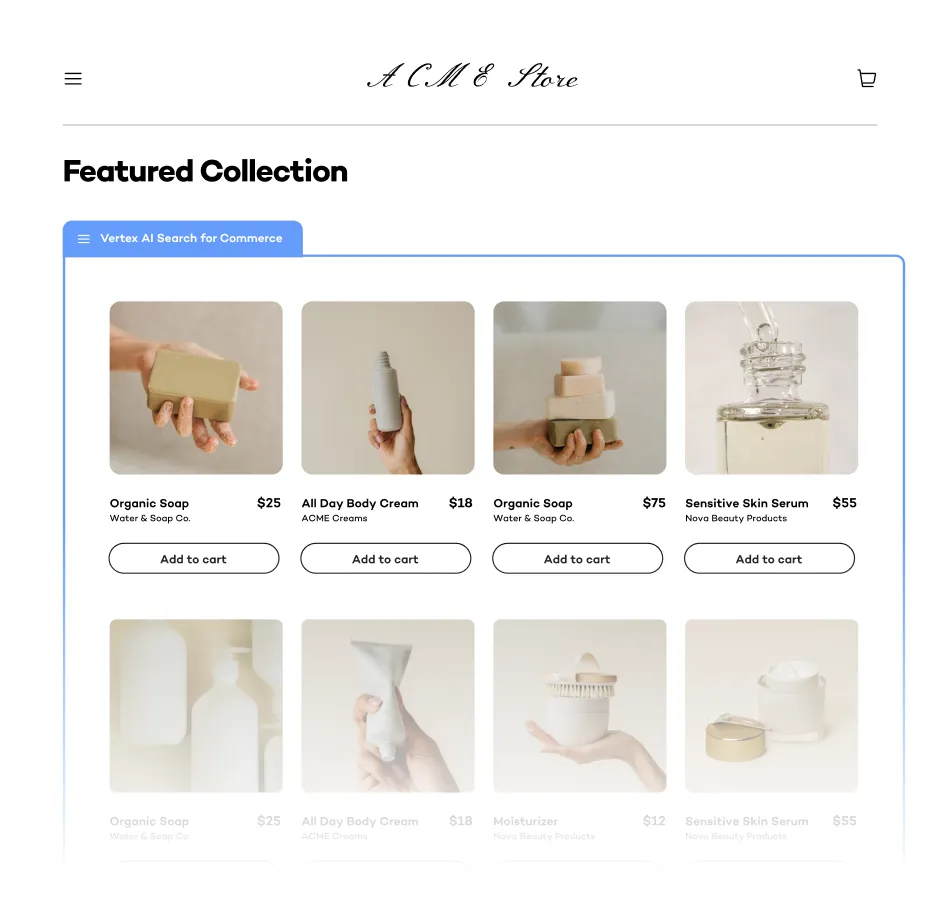
- Powered by Google's AI Commerce Search
- Search and collection discovery, with recommendations on supported plans
- Hosted plans or your own Google Cloud project on Enterprise
Before you switch
Questions to answer before replacing Boost
Boost already offers AI search and merchandising. A useful evaluation identifies a concrete gap in your store’s results or workflow.
Catalog relevance
Test compatibility terms, product attributes, synonyms, and out-of-stock handling against a shared query set. Do not equate AI branding with measured quality.
Daily merchandising
Recreate a collection campaign and a query promotion in each tool. Compare the effort and confirm which features your plan includes.
Total cost at your scale
Compare Boost’s current GMV-based plans with Nimstrata’s catalog and usage model. Include migration scope, support, and overlapping subscriptions.
Head to head
Two Shopify apps, different platforms and billing
Compare current product capabilities rather than assuming Boost is limited to manual keyword rules.
View the official sources and review method| Decision factor | Nimstrata | Boost Commerce |
|---|---|---|
| Storefront setup | Shopify App Blocks; custom theme work scoped separately | Shopify app with no-code setup |
| Billing inputs | Catalog size, plan, and search/browse queries | Current plans use GMV; legacy plans may differ |
| Rollout validation | Preview theme, catalog mapping, and query testing | Preview and validate your chosen configuration |
| Search | Google Cloud AI Commerce Search | AI search, including semantic search and AI synonyms |
| Merchandising and filters | Search and collection controls with dynamic facets | Filtering, merchandising, and collection tools |
| Recommendations and personalization | Recommendations on supported plans; confirm requirements | Recommendations; advanced personalization is plan-dependent |
Boost may be the better fit when its filtering and merchandising meet your needs, particularly if your existing rules work well. Nimstrata is worth evaluating when you want Google’s commerce models and can justify the full subscription and usage cost. Compare measured outcomes rather than treating either vendor as an automatic upgrade.
Total cost to operate
Compare the full monthly cost
Match catalog size, traffic, required features, and implementation work before comparing quotes. A base subscription is not the total bill.
Nimstrata
$99–$999 base/mo
- Starter and GrowthFrom $99 and $499/month, plus $3 per 1,000 search and browse queries. Hosted Google Cloud costs are included in that usage rate; catalog limits apply.
- EnterpriseFrom $999/month, plus $0.30 per 1,000 search and browse queries and separate Google Cloud usage. Confirm recommendation costs and onboarding scope.
Boost Commerce
From $29/month
- Current plan modelEntry pricing starts at $29/month. The selected tier and GMV affect the price; legacy subscriptions can have different terms.
- Confirm your quoteBoost’s website and Shopify listing show different higher-tier prices at review time. Use the current offer for your store; a 21-day trial is advertised.
Budget for theme work, data cleanup, query testing, and any overlap between subscriptions. Savings depend on your usage and requirements.
USD pricing reviewed September 18, 2026. Official sources. Estimate Nimstrata pricing for your catalog and traffic.
Sources and comparison method
Nimstrata publishes this comparison and sells Retail Cloud Connect. Product and pricing facts use the official sources below, reviewed September 18, 2026. Fit recommendations are our assessment, not an independent benchmark. Features and prices depend on plan and may change.
Customer proof
A documented move from Boost
Case study
PPD Performance deployed across seven stores
The published case study describes PPD Performance moving its automotive catalog from Boost to Retail Cloud Connect, including vehicle attributes and two recommendation models. It reports lower costs and improved search conversion without giving a numerical lift or a universal implementation timeline. This is one merchant’s experience, not a controlled comparison of today’s plans.
Shopify stores
7
Reported catalog size
100,000+ SKUs
Markets
AU + NZ
Read the full PPD Performance case study"The installation and implementation were seamless — everything worked exactly as described."
How the switch works
Migrating from Boost: preserve the behavior you need
A new provider does not automatically reproduce existing settings. Agree on acceptance criteria before changing the live storefront.
- 1
Record the current experience
Save important queries, synonyms, filters, merchandising rules, integrations, and conversion metrics. Include mobile, languages, markets, and unavailable products.
- 2
Validate in a preview theme
Sync the catalog and test search, collections, tracking, and recommendation placements. Recreate required settings and confirm rollback before launch.
- 3
Launch and measure
Publish after acceptance checks. Use a controlled experiment if your setup supports it, monitor conversion and no-result searches, and retire the old app after validation.
Risk handling checklist
- Keep the previous theme and provider available until the new setup is accepted.
- Compare similar traffic and record promotions or catalog changes that could affect results.
- Confirm that customer events, consent settings, and billing are configured before launch.
Use this checklist to scope a move from Boost Commerce. Timing and engineering support depend on your theme, integrations, and validation requirements.
FAQ
Common Questions
Does Boost offer semantic search?
Yes. Boost’s current product documentation describes AI search, semantic search, and AI synonyms. Evaluate the results and feature availability on the plan you would actually buy.
Will Boost’s filters and merchandising rules carry over?
Do not assume an automatic transfer. Document filter labels, variant behavior, synonyms, product promotions, and collection ordering, then recreate and test the requirements in a preview theme.
What does the PPD Performance case study prove?
It documents a move from Boost to Retail Cloud Connect across seven stores and more than 100,000 SKUs. It reports improved search conversion without publishing a percentage; it does not establish an expected lift for your store.
Should I switch if Boost already meets our needs?
A migration may not be worthwhile if search quality, workflow, and cost already meet your requirements. Establish the improvement you need and verify it on your catalog before committing.
Evaluate search on your own products
Bring your catalog, top queries, and current bill. Validate relevance and total cost before choosing a provider.
Self-serve
View the Shopify appAssisted rollout
Book a comparison walkthrough